Can You Build Muscle at 90? What the Research Says and How to Start Safely
Affiliate Disclosure: This page contains affiliate links. If you purchase through these links, I may earn a small commission at no extra cost to you. As an Amazon Associate, I earn from qualifying purchases. This helps support Active Aging Wearables and allows me to keep providing free guides for older adults and caregivers. I only recommend products I personally believe in and would use myself. Thank you for your support! Read our full affiliate disclosure.
Yes, you can gain muscle and strength at 90. Research going back to 1990 shows that people in their 90s who do regular strength training get noticeably stronger, and some even add measurable muscle, in as little as eight weeks. The key is to start with your doctor’s okay, begin gently, and build up slowly, ideally with someone guiding you at first.
Want a shortcut? Take our 3-question Red Light Therapy Quiz and get matched to the right device for your needs and budget.
Even in the 90s, muscle still responds when it works against resistance, whether that is a light weight, an elastic band, or your own body weight. Studies of people aged 90 and older have found large gains in leg strength, and in some cases better walking, better balance, and fewer falls.
You will not build the muscle of a 40 year old, and gains in muscle size are usually modest. But strength often improves far more than muscle size, and strength is what helps you get out of a chair, climb a step, carry groceries, and stay on your feet.
Key takeaways
- People in their 90s, including frail nursing home residents, have more than doubled their leg strength in 8 to 12 weeks.
- Light to moderate training works too, not just heavy lifting.
- Two sessions a week, started slowly and with supervision, is how most studies did it.
- Talk with your doctor before you start.
What the Research Shows
The 1990 study that changed minds: strength training in people aged 90 and older
In 1990, Dr. Maria Fiatarone and colleagues at Tufts University published a small but famous study in the Journal of the American Medical Association (JAMA). Ten frail nursing home residents, about 90 years old on average, did eight weeks of high intensity strength training for their legs.
The results surprised many doctors at the time:
- Leg strength rose by an average of 174% in the nine people who finished the program.
- Thigh muscle size grew by about 9%.
- Walking speed on a heel to toe walking test improved by 48%.
The researchers concluded that weight training led to significant gains in muscle strength, size, and mobility among frail nursing home residents up to 96 years of age. It was small, but it opened the door to decades of research.
A larger follow up trial with 100 nursing home residents
In 1994, the same research group ran a bigger, randomized trial published in the New England Journal of Medicine. It included 100 frail nursing home residents aged 72 to 98 (average age about 87). Over 10 weeks, those who did progressive strength training increased their muscle strength by about 113%, compared with about 3% in those who did not exercise.
The exercisers also walked faster (about 12% faster) and gained stair climbing power (about 28%), while the non exercisers did not. A nutrition supplement on its own did not improve strength. Exercise was the key ingredient.
Lighter training works too
Not everyone wants, or should try, high intensity training. A 2011 randomized trial in the Journal of the American Geriatrics Society studied 40 nursing home residents aged 90 to 97. Half did an eight week program of light to moderate leg strength exercises. Their leg press strength rose by about 10.6 kg (roughly 23 pounds), and they had fewer falls than the people who did not exercise.
Strength, balance, and walking combined
A 2014 randomized trial published in the journal Age followed 24 frail nursing home residents with an average age of almost 92. Twice a week for 12 weeks, the exercise group did a mix of strength and power exercises (moving a moderate weight a bit more quickly), plus balance and walking practice. Compared with the group that did not exercise, they improved strength and power, rose from a chair more easily, had better balance, increased their thigh muscle size, and had fewer falls. The non exercise group lost strength and function.
The big picture from reviews
Reviews that pool many studies give the clearest picture:
- A 2009 Cochrane review of 121 trials with about 6,700 older adults found that progressive resistance training substantially improved strength and produced smaller improvements in everyday abilities such as walking speed and getting up from a chair.
- A 2011 analysis in Medicine & Science in Sports & Exercise pooled 49 studies of adults aged 50 and older and found that resistance training added about 1.1 kg (about 2.4 pounds) of lean body mass on average. Older participants tended to gain somewhat less, which is a good reminder to keep expectations realistic.
Why Muscle Matters at 90
After about age 60, most people slowly lose muscle and strength, a process called sarcopenia. We cover the basics in our guide on how to maintain muscle after 60. By the 90s, that loss can start to affect almost everything you do in a day.
Fewer falls
Weak legs and poor balance are major reasons older adults fall. A large 2019 Cochrane review found that exercise programs for older people living at home reduced the rate of falls by about 23%.
Staying independent
Strength is what lets you do the small things that add up to independence: standing up from the toilet or sofa, getting in and out of a car, stepping onto a curb, and carrying a bag of groceries. Stronger legs can also bring back the confidence to walk to the mailbox or visit friends.
How to Start Safely
1. Talk with your doctor first
Before you start any new exercise program, especially in your 80s or 90s, check with your doctor. This is very important if you have heart problems, high blood pressure, osteoporosis, recent surgery, dizziness, joint replacements, or have fallen recently. Ask your doctor, “Is it safe for me to start strength exercises? Is there anything I should avoid?”
2. Get some supervision at the start
In the studies above, participants were guided by trained staff. That matters. A physical therapist, a senior fitness class, or a certified personal trainer who works with older adults can show you proper form, choose the right starting level, and watch for problems. For family members, simply being nearby during standing exercises adds a lot of safety.
3. Start light and progress slowly
The word “progressive” is the secret. Start with an amount that feels easy to moderate. When you can comfortably do 10 to 15 repetitions with good form, make it a little harder: a slightly heavier weight, a firmer band, or one more set. The CDC recommends that older adults do muscle strengthening activities on at least 2 days a week, along with balance activities, as their abilities allow.
4. Know when to stop
Mild muscle tiredness or slight soreness a day later is normal. Stop and call your doctor if you have chest pain, shortness of breath that does not settle, dizziness, sharp joint pain, or anything that feels wrong.
5. Keep track of your progress
A notebook works fine: write down the exercises, how many you did, and how you felt. A simple wearable can also count steps and remind you to move. See our picks for the best fitness trackers for people over 50.
Simple Beginner Exercises
These exercises can be done at home with little or no equipment. Use a sturdy chair without wheels, placed against a wall, and keep a counter or another person close by for balance. Start with 1 set of 5 to 10 repetitions and work up over the weeks.
- Sit to stand (chair stands): Sit near the front of a sturdy chair, feet flat. Lean slightly forward and stand up, using your hands on the armrests if needed. Slowly sit back down.
- Seated knee extensions: Sit tall and slowly straighten one leg out in front of you, hold for a moment, then lower it. Switch legs. Add an ankle weight later when it feels easy.
- Seated marching: Sitting tall, lift one knee up, lower it, then the other, like marching in place.
- Heel raises: Stand behind a chair or at the kitchen counter, holding on with both hands. Rise up onto your toes, then lower slowly.
- Wall push ups: Stand an arm’s length from a wall, hands flat on the wall at shoulder height. Bend your elbows to bring your chest toward the wall, then push back.
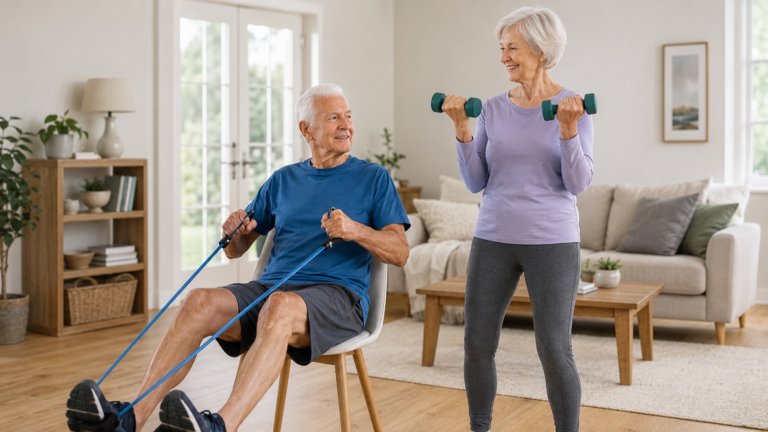
- Seated band rows: Loop a resistance band around your feet while seated. Hold the ends and pull your elbows back, squeezing your shoulder blades together.
- Seated bicep curls: Holding light dumbbells or soft weights with palms facing up, bend your elbows to bring the weights toward your shoulders, then lower slowly.
Breathe normally throughout and do not hold your breath. Move slowly and with control rather than quickly.
Beginner Friendly Home Equipment
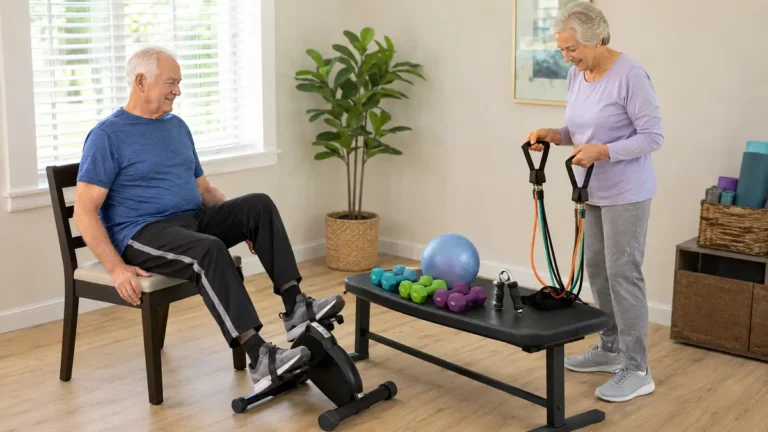
You do not need a gym. A few inexpensive items can help you progress at home. For a deeper look, see our full guide to strength training equipment for older adults. The links below are affiliate links that open an Amazon search, so you can compare options, prices, and reviews.
1. Resistance bands
Light, inexpensive, and gentle on joints. Bands come in different strengths, usually by color, so you can move up as you get stronger. Handles are easier to grip with arthritic hands.
Shop resistance bands with handles on Amazon
2. Light dumbbells or soft hand weights
Soft, padded weights of 1 to 3 pounds are a good start for many beginners and are less worrying if dropped. Light adjustable dumbbells let you add small amounts of weight without buying a whole new set.
Shop soft hand weights on Amazon
Shop light adjustable dumbbells on Amazon
3. Adjustable ankle weights
Ankle weights make seated knee extensions and leg lifts more challenging. Choose an adjustable pair so you can start very light, and use them for slow, seated or supported exercises, not for walking around.
Shop adjustable ankle weights on Amazon
4. A sturdy chair exercise option
Many of the best beginner exercises are done sitting down. A sturdy, armed chair without wheels is the starting point. Some people also add a seated exercise kit. Whatever you choose, make sure the chair will not slide or tip.
Shop chair exercise equipment on Amazon
5. A pedal exerciser
A small pedal exerciser sits on the floor in front of your chair so you can “bike” while seated. It is not strength training, but it is a gentle way to warm up and keep legs moving while watching TV. Look for one with adjustable resistance and a non slip base.
Shop pedal exercisers on Amazon
Frequently Asked Questions
Is it too late to start strength training at 85 or 90?
No. Several of the studies above were done with people in their late 80s and 90s, including frail nursing home residents, and they still got stronger. With your doctor’s approval and a slow start, it is rarely too late to benefit.
How long does it take to see results?
In the studies of people in their 90s, strength improvements showed up within 8 to 12 weeks of regular training, usually 2 to 3 sessions a week. Many people notice everyday changes, like standing up more easily, before their muscles look any different.
Do I need to eat more protein?
Muscle is built from protein, and many older adults do not get enough. Talk with your doctor or a dietitian about what is right for you, especially if you have kidney disease. Our guide to protein after 60 explains the basics. Remember that in the 1994 study, a nutrition supplement alone did not improve strength. Exercise was what made the difference.
Should I take creatine to build muscle?
Creatine is a widely studied supplement for muscle, but it is not right for everyone, so ask your doctor first. Read more in our article on creatine for older adults.
Is it safe to lift weights with osteoporosis or arthritis?
Many people with these conditions can do strength exercises safely, but the right exercises depend on your situation, and some movements may need to be avoided. Ask your doctor or a physical therapist to tailor a program for you.
Sources
- Fiatarone MA, et al. High intensity strength training in nonagenarians. Effects on skeletal muscle. JAMA. 1990;263(22):3029 to 3034.
- Fiatarone MA, et al. Exercise training and nutritional supplementation for physical frailty in very elderly people. N Engl J Med. 1994;330(25):1769 to 1775.
- Serra Rexach JA, et al. Short term, light to moderate intensity exercise training improves leg muscle strength in the oldest old: a randomized controlled trial. J Am Geriatr Soc. 2011;59(4):594 to 602.
- Cadore EL, et al. Multicomponent exercises including muscle power training enhance muscle mass, power output, and functional outcomes in institutionalized frail nonagenarians. Age. 2014;36(2):773 to 785.
- Liu CJ, Latham NK. Progressive resistance strength training for improving physical function in older adults. Cochrane Database Syst Rev. 2009.
- Peterson MD, Sen A, Gordon PM. Influence of resistance exercise on lean body mass in aging adults: a meta analysis. Med Sci Sports Exerc. 2011.
- Sherrington C, et al. Exercise for preventing falls in older people living in the community. Cochrane Database Syst Rev. 2019.
- Centers for Disease Control and Prevention. Physical activity guidelines for older adults.
Medical Disclaimer
This article is for general information only and is not medical advice. Always talk with your doctor before starting a new exercise program, changing your diet, or taking a supplement, especially if you have a health condition, take medications, or have recently fallen.
3 Comments
Comments are closed.