Best Strength-Training Equipment for Older Adults: Simple Home Exercise Gear
The best strength-training equipment for older adults should be comfortable, stable, easy to understand, and adjustable as strength improves.
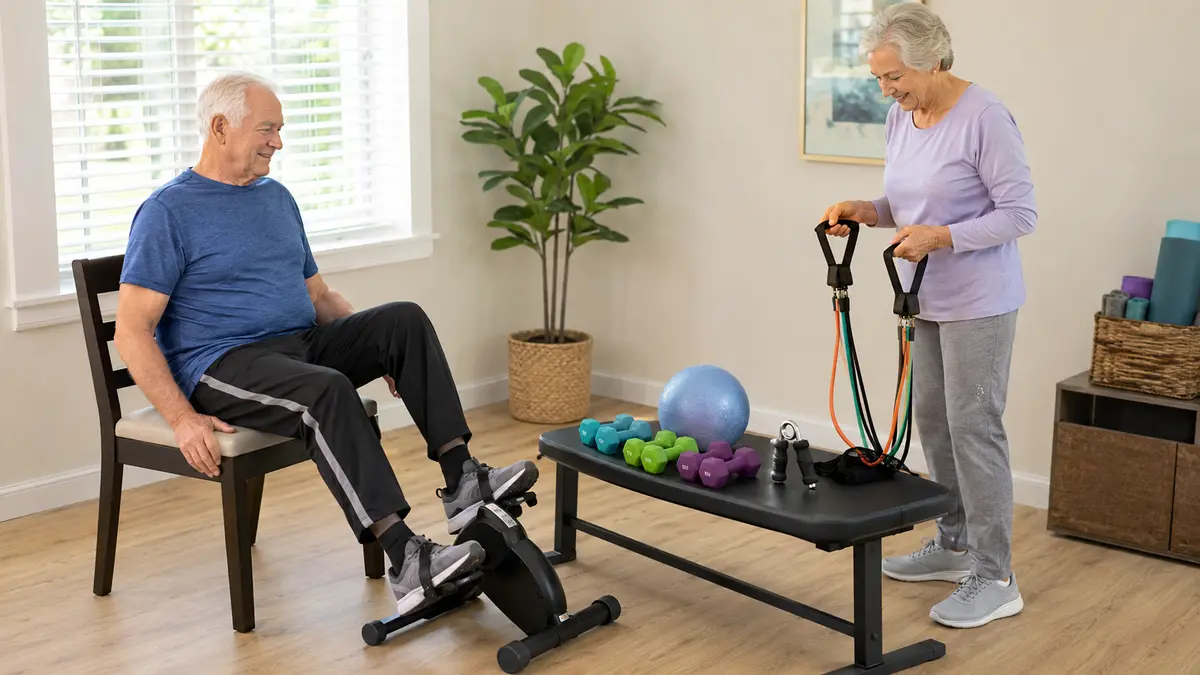
You do not need a room full of machines. A sturdy chair, resistance bands, and a pair of light dumbbells can support a surprisingly complete home routine. Other products may help with grip, seated exercise, or adding variety, but buying more equipment does not guarantee better results.
This guide compares practical home exercise equipment, explains what each item does, and points out safety details that matter more with age.
Affiliate disclosure: This article contains affiliate links. As an Amazon Associate I earn from qualifying purchases. This does not affect the price you pay. Read our full affiliate disclosure.
This article provides general educational information and is not medical advice. Speak with a qualified healthcare professional or physical therapist before beginning a new exercise program, especially if you have heart, lung, balance, joint, or other medical concerns.
Why Strength Equipment Can Help
Strength training makes muscles work against resistance. That resistance can come from your body weight, a band, a dumbbell, a machine, or another weighted object.
The CDC recommends that adults aged 65 and older perform muscle-strengthening activities at least two days per week and include balance and aerobic activity.
Equipment is useful because it can make resistance easier to control and gradually increase. The right product may also make an exercise more comfortable or convenient.
However, equipment should fit the person—not the other way around. A complicated adjustable dumbbell or an unstable balance platform may be more frustrating than helpful.
For a simple starting routine, read How to Maintain Muscle After 60.
How We Chose These Equipment Types
These recommendations focus on:
- Ease of use
- Adjustable or gradual resistance
- Comfortable handles and surfaces
- Storage requirements
- Versatility
- Suitability for seated or standing exercise
- Risk of rolling, slipping, or snapping
- Value for someone exercising at home
These are product categories rather than guarantees about every item sold within them. Quality can vary considerably between manufacturers and sellers.
Quick Comparison
| Equipment | Best for | Main advantage | Important caution |
|---|---|---|---|
| Resistance bands with handles | Best overall starter equipment | Lightweight, versatile, and easy to store | Bands and anchors must be inspected |
| Neoprene dumbbells | Simple lifting exercises | Easy to understand and available in gradual weights | Choose a weight you can control |
| Soft weighted exercise ball | Seated and two-handed exercises | Easier to grip than many dumbbells | Do not throw it or lift it overhead without guidance |
| Adjustable hand gripper | Hand and forearm exercise | Small, inexpensive, and portable | Does not provide a full-body workout |
| Pedal exerciser | Seated movement and light leg resistance | Useful when standing exercise is difficult | Primarily supports movement and endurance, not complete strength training |
1. Best Overall: Resistance Bands With Handles
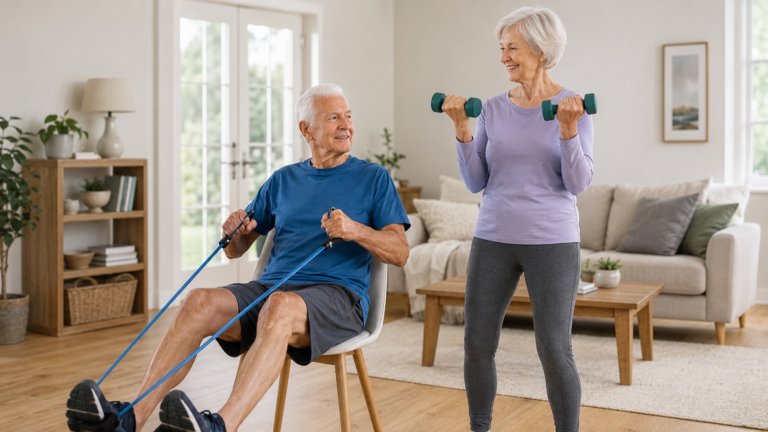
Resistance bands are one of the most useful and affordable choices for home strength training.
They can be used for:
- Seated rows
- Chest presses
- Arm curls
- Triceps exercises
- Leg extensions
- Side steps
- Hip exercises
- Gentle shoulder work
Handled tube bands may be easier to grip than flat bands for someone with limited hand strength. Sets commonly include several resistance levels, allowing a beginner to start lightly and increase gradually.
Some sets include door anchors and ankle straps. These accessories add exercise options, but they also introduce additional setup and safety concerns.
What to Look For
- Several clearly identified resistance levels
- Comfortable nonslip handles
- Secure connections between the band and handle
- A storage bag
- Simple instructions
- A protective sleeve around the tubing when available
- Replacement bands sold by the manufacturer
- A door anchor with clear placement instructions
Before each use, inspect the entire band for cracks, cuts, worn areas, or damaged connections. The American Council on Exercise specifically advises checking bands and handles for damage before exercising. See the ACE resistance-band guidance.
Never attach a band to an unstable chair, loose railing, sharp object, or door that could open unexpectedly. Keep the band away from the face and eyes.
See the Bodylastics resistance band set on Amazon
2. Best Simple Weights: Neoprene Dumbbells
Dumbbells are familiar and straightforward. You pick them up, perform the exercise with controlled movement, and put them down securely.
They can be used for:
- Arm curls
- Seated or standing rows
- Light overhead presses when appropriate
- Front raises
- Supported squats
- Short carries
- Chest exercises
Neoprene-coated dumbbells are often more comfortable to hold than bare metal. A hexagonal or flat-sided shape helps prevent the weights from rolling across the floor.
What to Look For
- A manageable starting weight
- A comfortable nonslip coating
- Clearly printed weight markings
- Flat sides that prevent rolling
- A grip diameter that fits the user’s hand
- Individual pairs or a small gradual set
- A stable storage rack if buying several pairs
Do not buy a large set simply because it is discounted. Many beginners only need one or two light pairs at first.
Someone with arthritis may find a thick handle uncomfortable. If possible, hold the dumbbell in a store before purchasing or choose a retailer with a reasonable return policy.
See the Amazon Basics 3 lb neoprene dumbbell pair on Amazon
3. Best for Seated Exercises: Soft Weighted Exercise Ball
A soft weighted ball can be useful for older adults who prefer seated exercise or find traditional dumbbell handles difficult to grip.
Depending on ability and professional guidance, it may be used for:
- Two-handed presses
- Gentle torso movements
- Seated lifts
- Passing from one hand to the other
- Controlled reaching
- Holding during chair sit-to-stands
The National Institute on Aging includes medicine balls and resistance bands among the tools that can be used for strength training.
For home use, a soft weighted ball is generally more forgiving than a hard medicine ball if it is accidentally dropped.
What to Look For
- A soft or lightly textured surface
- A weight that can be controlled with two hands
- Clear weight markings
- A size that is easy to grip
- Stitching or seams that appear secure
- A design intended for exercise rather than children’s play
Do not throw the ball indoors or perform fast twisting movements. Overhead movements may not be suitable for someone with shoulder problems.
See the Retrospec soft weighted ball (4 lb) on Amazon
4. Best for Hand Strength: Adjustable Hand Gripper
Hand strength affects many everyday activities, including opening containers, carrying bags, holding railings, gardening, and using household tools.
An adjustable hand gripper provides resistance when the handles are squeezed together. Adjustable models allow the resistance to increase gradually without buying several separate grippers.
What to Look For
- Low enough starting resistance
- Clearly marked adjustments
- Padded, textured, or nonslip handles
- A size that fits comfortably in the hand
- Smooth movement without sticking
- A quiet mechanism
- Simple resistance adjustment
A hand gripper works only a small part of the body. It should supplement a broader program rather than replace exercises for the legs, hips, back, chest, and shoulders.
People with painful arthritis, recent hand surgery, tendon problems, or numbness should ask a healthcare professional or occupational therapist whether a gripper is appropriate.
See the Exology adjustable hand gripper on Amazon
5. Best Seated Movement Option: Pedal Exerciser
A compact pedal exerciser can be placed in front of a sturdy chair for seated leg movement. Some models can also sit on a table for light arm pedaling.
It may be useful for someone who:
- Has difficulty exercising while standing
- Wants to move while watching television
- Is rebuilding activity gradually
- Needs a compact alternative to a stationary bicycle
- Wants light adjustable resistance
A pedal exerciser is mainly an activity and endurance tool. Even when it offers resistance, it does not replace full-body strength training.
What to Look For
- A wide, stable base
- Nonslip feet
- Adjustable resistance
- Pedal straps that are easy to use
- A display that is large enough to read
- Enough clearance for the knees
- A weight that will not slide easily
- Compatibility with the height of the chair
Use a sturdy chair that does not roll. Place the exerciser on a nonslip surface and make sure the knees do not hit the underside of a table or desk.
See the TABEKE pedal exerciser on Amazon
Equipment You May Not Need
Some products can be useful in the right setting but are not ideal starting choices for everyone.
Heavy Adjustable Dumbbells
Space-saving adjustable dumbbells can be convenient for experienced exercisers. However, some are bulky, require twisting small controls, or begin at a weight that is too heavy.
Unstable Balance Boards
Balance equipment creates instability on purpose. That may be appropriate with supervision, but it can increase fall risk when used alone.
Weighted Vests
Weighted vests may increase the challenge of walking or standing exercises. They can also affect balance, joints, breathing, and fatigue. Obtain professional guidance before using one.
Ankle Weights for Walking
Ankle weights may alter walking mechanics and place additional stress on joints. They should not automatically be worn during neighborhood walks. A clinician or physical therapist may recommend them for specific controlled exercises.
Large Exercise Balls
Stability balls can roll unexpectedly and require considerable balance. A sturdy chair is a safer choice for many beginners.
The Best Beginner Home Setup
Most beginners do not need every product in this guide.
A practical starting setup is:
- A sturdy chair without wheels
- A resistance-band set with handles
- One pair of light neoprene dumbbells
- Clear floor space
- Support from a wall or counter when needed
Begin with exercises you can perform safely and consistently. Add another product only when it solves a clear problem or provides useful progression.
Strength training also works best with adequate nutrition. See our Protein After 60 guide, and if you are considering supplementation, read our Creatine for Older Adults guide.
Buying Tips Before You Order
- Start lighter than your ego suggests. Control matters more than the number printed on the equipment.
- Check hand comfort. Arthritis and limited grip strength can make certain handles difficult.
- Measure the exercise space. Include room for bands, arms, and safe movement.
- Avoid complicated adjustments. Equipment should be understandable without watching a long video every time.
- Confirm return policies. A product may look comfortable online but feel completely different at home.
- Read recent verified-purchase reviews. Look for repeated complaints about breakage, odors, rough handles, inaccurate resistance, or missing parts.
- Check the seller. Confirm who sells and ships the item and whether the manufacturer’s warranty applies.
- Do not rely on the word “senior.” Products marketed to seniors are not automatically safer or easier to use.
- Inspect equipment regularly. Replace cracked bands, loose handles, damaged seams, or unstable equipment.
- Buy for the current user. Equipment that is too difficult will probably remain unused.
Basic Home Exercise Safety
- Clear rugs, cords, pets, and clutter from the exercise area.
- Use a sturdy chair or counter for support.
- Wear secure footwear on a nonslip floor.
- Move slowly enough to remain in control.
- Avoid holding your breath during exertion.
- Stop for sharp pain, chest discomfort, faintness, or severe shortness of breath.
- Do not exercise alone if you have a significant fall risk.
- Ask for professional help when you are uncertain about technique.
The National Institute on Aging advises people with chronic conditions to build activity gradually and discuss appropriate exercise with a healthcare professional.
Common Buying Mistakes
- Purchasing every piece of equipment at once
- Choosing resistance that is too heavy
- Buying bands without checking the handles and connections
- Using a wheeled chair with a pedal exerciser
- Assuming a hand gripper provides a complete workout
- Buying unstable balance equipment without supervision
- Ignoring arthritis, shoulder limitations, or hand size
- Choosing equipment that is difficult to store or assemble
- Keeping damaged bands because they still “mostly work”
- Expecting equipment to create motivation by itself
You may also see red light therapy devices marketed for joint pain and recovery. See our guide to red light therapy for older adults for what the research says and who should be cautious.
Bottom Line
The best strength-training equipment for older adults is equipment that feels comfortable, fits the available space, provides appropriate resistance, and gets used consistently.
For most beginners, handled resistance bands are the best overall choice. Light neoprene dumbbells provide familiar resistance, while soft weighted balls can make seated exercise more comfortable. Hand grippers support grip work, and pedal exercisers offer a useful seated movement option.
Begin with a sturdy chair, a simple band set, and perhaps one pair of light dumbbells. Learn a few controlled exercises before buying additional gear.
The goal is not to create a home gym that looks impressive. It is to make regular strength training easier, safer, and more practical.
Product availability, construction, prices, warranties, and retailer listings can change. Verify current details before purchasing. This article provides general educational information and is not medical advice.


One Comment
Comments are closed.