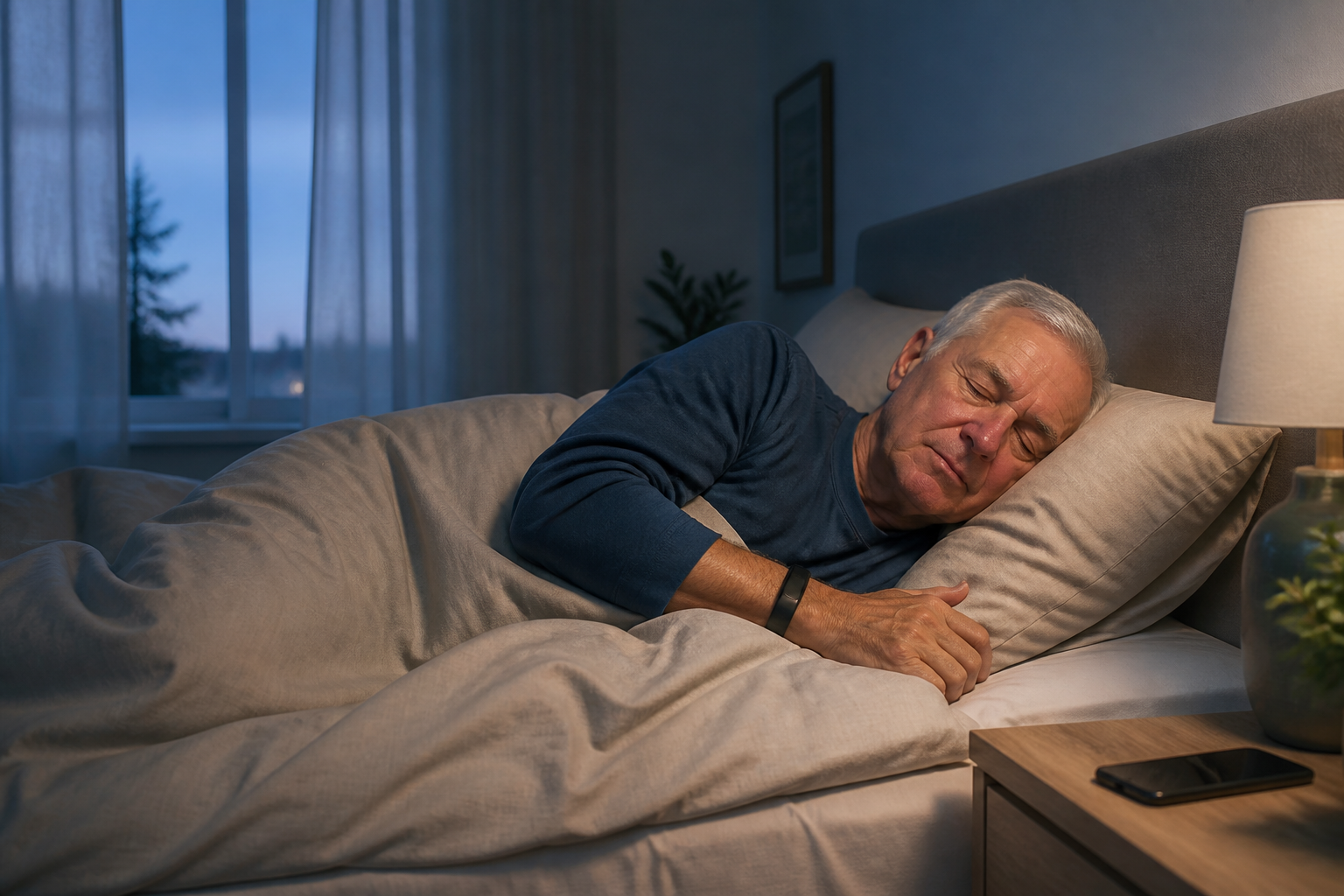
Best Sleep Trackers for Older Adults in 2026
Affiliate Disclosure: This page contains affiliate links. If you purchase through these links, I may earn a small commission at no extra cost to you. As an Amazon Associate, I earn from qualifying purchases. This helps support Active Aging Wearables and allows me to keep providing free guides for older adults and caregivers. I only recommend products I personally believe in and would use myself. Thank you for your support! Read our full affiliate disclosure.
The best sleep trackers for older adults are not necessarily the devices with the longest list of measurements. Whether you’re choosing one for yourself or a sleep tracker for a senior parent, the best choice is a device that is comfortable enough to wear every night, simple enough to understand in the morning, and easy to keep charged.
For many people, a lightweight fitness band is the easiest starting point. A smart ring can be more comfortable in bed, while a full smartwatch may make more sense if you also want a larger screen, exercise features, or emergency tools.
This guide compares four options and explains what their numbers can—and cannot—tell you about your sleep.
This article provides general information and is not medical advice.
Quick answer: Among these four devices, the Fitbit Inspire 3 is our simple starting choice, the Oura Ring 4 suits people who dislike sleeping in a watch, the Garmin vívoactive 6 offers longer advertised battery life in a full smartwatch, and the Apple Watch SE 3 fits many iPhone users who also value safety and communication features.
Quick comparison
| Device | Best for | Advertised battery | Important consideration |
|---|---|---|---|
| Fitbit Inspire 3 | Simple, lightweight tracking | Up to 10 days | Optional paid coaching and additional features |
| Oura Ring 4 | Tracking without a watch screen | Up to 8 days | Detailed sleep analysis requires an ongoing membership |
| Garmin vívoactive 6 | Sleep plus walking and fitness | Up to 11 days | More menus and data than a basic tracker |
| Apple Watch SE 3 | iPhone users who want an all-purpose watch | Up to 18 hours | Usually needs daily charging |
Battery estimates are manufacturer claims. Actual results vary with display settings, workouts, notifications, battery age, and other features.
How we chose these sleep trackers
These recommendations are based on manufacturer specifications, phone compatibility, comfort-related features, charging frequency, clarity of the sleep information, and usefulness for an older wearer. We also considered whether the device remains helpful during the day.
We did not laboratory-test these products. Comfort varies from person to person, and these recommendations are not a ranking of independently tested sleep accuracy. Consumer wearables estimate sleep using signals such as movement and heart rate; they are not the same as a clinical sleep study.
1. Best simple sleep tracker: Fitbit Inspire 3
The Fitbit Inspire 3 is a practical choice for someone who wants sleep and activity trends without wearing a large smartwatch.
Its lightweight design and advertised battery life of up to 10 days matter at night: a tracker cannot collect useful trends if it feels bulky or spends bedtime on the charger.
Fitbit reports a sleep score, estimated time in light, deep, and REM sleep, sleeping heart rate, and schedule consistency. It also tracks steps and everyday activity, making it a useful option for someone who wants to compare sleep habits with walking and exercise.
Why it may work well for older adults
- Lightweight, narrow band
- Long advertised battery life
- Automatic sleep detection
- Simple daily sleep score
- Works with compatible iPhone and Android phones
Phone compatibility and ongoing costs
Google currently lists support for most phones running Android 11 or later or iOS 16.4 or later. A Google account and internet access are required. Confirm the requirements for the Google Health app before buying, especially if the wearer has an older phone.
Standard sleep tracking, sleep stages, and Sleep Score are listed among the device’s features. Google Health Premium is an optional membership for additional coaching and features. Check which features are included and which require payment before starting a subscription.
Things to consider
- The screen is smaller than a smartwatch display.
- Reviewing detailed information on a phone may be easier than reading it on the band.
- Some advanced coaching and additional features require a paid service.
- It does not provide automatic fall detection or cellular emergency calling.
Check the current Fitbit Inspire 3 price on Amazon
If everyday activity is as important as sleep, see our guide to the best fitness trackers for active adults over 50.
2. Best for people who dislike sleeping in a watch: Oura Ring 4
The Oura Ring 4 is designed for people who want detailed overnight trends without a screen on the wrist. Its smooth interior and ring shape may feel less intrusive than a watch under blankets or against a pillow.
Update: Oura released the smaller Oura Ring 5 in May 2026, and the Ring 4 is still sold in a wider range of sizes. Compare both, plus rings with no subscription, in our guide to smart rings for older adults.
With an active membership, Oura provides detailed sleep analysis, estimated sleep stages, bedtime guidance, nighttime heart rate and heart-rate variability, temperature variation, and other recovery information. The ring works with compatible iPhone and Android phones, and Oura advertises up to eight days of battery life.
Why it may work well for older adults
- No bright on-device display or wrist notifications
- Discreet design that some people prefer for sleeping
- Several days of advertised battery life
- Clear emphasis on sleep, readiness, and recovery trends
Membership cost
As checked in September 2026, Oura Membership costs $5.99 per month or $69.99 per year in the United States, with applicable taxes extra. New members receive one included month with their ring purchase. Without membership, the app shows the three daily Sleep, Readiness, and Activity scores and limited basic information; detailed sleep analysis requires membership. Include that ongoing cost in your budget and confirm current terms before buying.
Things to consider
- Correct sizing is essential, especially if fingers swell or change size.
- Use the sizing kit intended for the exact ring model rather than assuming an ordinary jewelry size will fit.
- People with arthritis or limited hand dexterity may prefer a wrist device.
- Detailed sleep information requires an ongoing membership.
- There is no on-device display, so you need a compatible phone to review the information.
Check current Oura Ring 4 options on Amazon
3. Best full smartwatch for battery life among these picks: Garmin vívoactive 6
The Garmin vívoactive 6 is an option for active adults who want sleep tracking, walking and exercise tools, built-in GPS, and a bright watch display without charging every day.
Garmin advertises up to 11 days of battery life in smartwatch mode. The watch reports total sleep, estimated stages, movement, and a sleep score. It also offers nap tracking, Sleep Coach, and a smart wake alarm.
These tools may help someone notice patterns in sleep and activity, but a sleep recommendation or estimated stage is not a medical assessment.
Why it may work well for older adults
- Long advertised battery life for a full smartwatch
- Sleep score, nap tracking, and Sleep Coach
- Bright AMOLED display
- Built-in GPS and broad fitness tracking
- Works with compatible iPhone and Android phones
Things to consider
- The menus and amount of data may feel busy to someone who wants only a simple sleep total.
- Confirm that the wearer’s phone supports the current Garmin Connect app.
- Garmin’s Incident Detection should not be confused with all-day fall detection; it works during supported activities and requires the necessary phone connection and setup.
- The vívoactive 6 does not provide independent cellular emergency calling.
- Pulse Ox use and display settings can reduce battery life.
Check the current Garmin vívoactive 6 price on Amazon
4. Best for iPhone users who want safety features too: Apple Watch SE 3
The Apple Watch SE 3 makes sense for an older adult who already uses a compatible iPhone and wants one device for sleep, calls, messages, activity, and safety features.
Apple’s Sleep app estimates time spent awake and in REM, Core, and Deep sleep. The watch also provides a sleep score and can show overnight information such as heart rate, respiratory rate, wrist temperature, and sleep duration in the Vitals app when supported and properly configured.
The trade-off is battery life. Apple advertises up to 18 hours of normal use, so most wearers need a reliable charging routine. Fast charging helps, but someone who regularly forgets to charge devices may get more complete sleep trends from a longer-lasting tracker.
Phone compatibility
Apple Watch SE 3 requires an iPhone 11 or later, including iPhone SE (2nd generation or later). Apple currently lists iOS 27 or later on its product page, so update the iPhone to the latest version of iOS before setting up the watch. It does not pair normally with Android phones.
Why it may work well for older adults
- Readable screen with accessibility settings
- Sleep score and sleep-stage estimates
- Fall Detection, Crash Detection, and Emergency SOS when configured and connected as required
- Calls, messages, reminders, and broad health and fitness features
Things to consider
- It requires a compatible iPhone.
- Daily charging can interrupt overnight tracking.
- More features also mean more setup and menus.
- Cellular models cost more, and a carrier plan may add a monthly charge for connected services.
- Fall detection cannot recognize every fall or guarantee emergency assistance.
Apple also lists sleep apnea notifications on supported SE 3 configurations. Availability and eligibility restrictions apply. Such a notification is a reason to seek medical evaluation, not a diagnosis; the absence of a notification does not rule out a problem.
Check the current Apple Watch SE 3 price on Amazon
For a broader comparison, read our guide to the best smartwatches for older adults. Caregivers may also want our guide to smartwatches with fall detection.
What matters most when choosing a sleep tracker after 60
Comfort comes first
A technically impressive tracker is not useful if it comes off every night. Consider band softness, case thickness, clasp difficulty, skin sensitivity, and whether the wearer sleeps with a hand under the pillow. A ring can be unobtrusive for one person and irritating for another.
If the band that comes with a tracker feels stiff or sweaty overnight, a soft, breathable replacement band can make a real difference. Compare soft replacement bands for Fitbit Inspire 3 on Amazon. Confirm the band fits the exact model before ordering.
Battery life must fit the routine
Longer battery life reduces gaps in the record. If you choose a device that needs frequent charging, connect charging to a daily habit such as breakfast or evening reading instead of leaving it on the charger overnight.
A charging stand kept in the same spot, such as beside the breakfast table or reading chair, makes that routine easier to remember. Compare Apple Watch charging stands on Amazon.
The app should show trends clearly
One unusual night rarely tells the whole story. Look for weekly and monthly views that make it easy to notice changes in bedtime and estimated sleep duration. The app’s text size and complexity matter as much as the tracker itself.
Check phone compatibility before buying
Some devices work with both iPhone and Android, while Apple Watch requires an iPhone. Confirm the exact phone model and operating-system requirements with the manufacturer before purchase. Someone buying a tracker as a gift should check the recipient’s phone first.
Include ongoing costs
Compare the device price with the cost of any membership needed for the features you want. Oura’s detailed sleep analysis requires membership, while other products may offer optional paid coaching or additional services. Check what remains available if you cancel a trial or subscription.
Decide whether you want sleep tracking or an all-purpose wearable
A ring or slim band is often best for quiet overnight tracking. A smartwatch may offer more value if you also want a readable clock, GPS walks, reminders, calls, or emergency features. You can browse more options on our wearable products page.
If heart-rate tracking during walks is also important to you, see our Best Heart Rate Monitors for Walking guide.
How accurate are consumer sleep trackers?
Wearables do not directly measure sleep in the same way as a laboratory sleep study. They use movement, heart-rate patterns, and other sensor information to estimate when you are asleep and how your night may be divided into stages.
Treat the numbers as estimates and look for patterns over time rather than assuming every minute or stage is exact. A tracker’s report should be considered alongside how you feel and any symptoms you experience.
The American Academy of Sleep Medicine cautions that consumer sleep technology is no substitute for medical evaluation. Tracking information can help start a conversation with a healthcare professional, but ordinary sleep scores and stage estimates should not be used on their own to diagnose or treat a sleep disorder.
When to talk with a healthcare professional
Talk with a qualified healthcare professional if you regularly struggle to fall or stay asleep, feel excessively sleepy during the day, snore loudly, wake up gasping, or notice a persistent change that concerns you.
Do not use a reassuring score to dismiss symptoms, and do not panic over one poor score when you feel well. Bring a few weeks of trends—and notes about bedtime, medications, caffeine, alcohol, exercise, and symptoms—to the appointment if your clinician is willing to review them.
Bottom line
For a simple and lightweight starting point, the Fitbit Inspire 3 is a practical choice for many older adults. Consider the Oura Ring 4 if sleeping without a watch matters most and its membership fits your budget, the Garmin vívoactive 6 if you want longer battery life plus walking and fitness features, or the Apple Watch SE 3 if you use a compatible iPhone and want communication and safety tools in the same device.
Whichever style you choose, prioritize comfort, a realistic charging routine, and an app you can understand. Use the data to notice long-term habits—not as a diagnosis or a nightly grade of your health.
Sources
- National Institute on Aging: Sleep and Older Adults
- American Academy of Sleep Medicine: Consumer Sleep Technology Is No Substitute for Medical Evaluation
- Oura: Membership Costs and Included Features
- Garmin vívoactive 6 Owner’s Manual: Sleep Tracking
- Apple Watch SE 3 Technical Specifications
- Apple Support: Track Your Sleep With Apple Watch
Sleep scores and stage estimates provide general wellness information. They do not diagnose sleep apnea, insomnia, or other medical conditions and do not replace care from a qualified healthcare professional. Features, subscriptions, compatibility, and battery claims can change; confirm current details with the manufacturer before purchasing.
A tracker shows how you slept, but your bedroom setup affects how well you sleep. For practical changes, from cooling sheets to neck-support pillows, see our guide to better sleep after 60.>

One Comment
Comments are closed.