Best Blood Pressure Monitors for Older Adults
The best blood pressure monitors for older adults combine a properly
sized upper-arm cuff, readable numbers, straightforward controls, and
enough memory to make tracking easier. Extra features such as Bluetooth
can be useful, but only if the person taking the readings will actually
use them.
Affiliate disclosure: This article contains
affiliate links. As an Amazon Associate I earn from qualifying
purchases. This does not affect the price you pay. Read our full affiliate
disclosure.
A home blood pressure monitor can help you record readings between
medical appointments and show your clinician how your blood pressure
changes over time. It cannot diagnose high blood pressure by itself or
tell you how to adjust medication.
This guide provides general information and is not medical advice.
Follow the measurement schedule and treatment plan given by your
healthcare professional.
Quick Picks
| Product | Best for | Notable features |
|---|---|---|
| OMRON Platinum BP5465 | Best overall and best for two users | Large backlit display, 100 readings per user, averaging, Bluetooth |
| OMRON 3 Series BP7150 | Simple everyday use | One-button operation, wide-range cuff, 14 readings, optional app |
| A&D Medical UA-767F | A household with up to four users | Four user profiles, 60 readings per user, one-button operation |
| Withings BPM Connect | App-based tracking | Compact design, Wi-Fi and Bluetooth syncing, app history |
What Matters
Most in a Home Blood Pressure Monitor?
Choose an Upper-Arm
Monitor When Possible
The American Heart Association recommends an automatic, cuff-style
upper-arm monitor for home use. Wrist monitors can be convenient when an
upper-arm cuff cannot be used, but they are more sensitive to body
position and may produce inconsistent results if the wrist is not held
at heart level.
Whatever type you choose, look for a device that has undergone
recognized clinical validation. The U.S. Blood Pressure Validated Device
Listing and STRIDE BP are
useful places to check particular model numbers.
Measure Your Arm Before
Buying
A cuff that is too small or too large can distort a reading. Measure
around the midpoint of the bare upper arm and compare that measurement
with the manufacturer’s cuff range.
Do not assume that a cuff described as “standard” or “wide range”
will fit everyone. Check the actual measurement in inches or
centimeters.
Prioritize a Readable
Display
Look for:
- Large numbers
- Strong contrast
- A backlight if readings will be taken in dim light
- Clearly labeled systolic, diastolic, and pulse results
- Error symbols that are easy to understand
A large, uncluttered screen is usually more valuable than a long list
of features hidden inside an app.
Keep the Controls Simple
One-button operation is helpful for someone who does not want
complicated menus. If two or more people will share the monitor, make
sure the user selector is easy to understand so readings are saved in
the correct history.
Decide How Much Memory You
Need
On-device memory is useful even if you keep a written log. A couple
sharing a monitor should look for separate user profiles. Some connected
models store more readings in an app than on the monitor itself.
Treat Irregular-Rhythm Alerts as Alerts
Some monitors display an irregular-heartbeat or possible atrial-fibrillation alert. These features do not provide a diagnosis. Discuss repeated or unexpected alerts with a healthcare professional.
If you also monitor heart rate during walking or exercise, see our Best Heart Rate Monitors for Walking guide.
Alerts as Alerts
Some monitors display an irregular-heartbeat or possible
atrial-fibrillation alert. These features do not provide a diagnosis.
Discuss repeated or unexpected alerts with a healthcare
professional.
How to Take a More
Reliable Home Reading
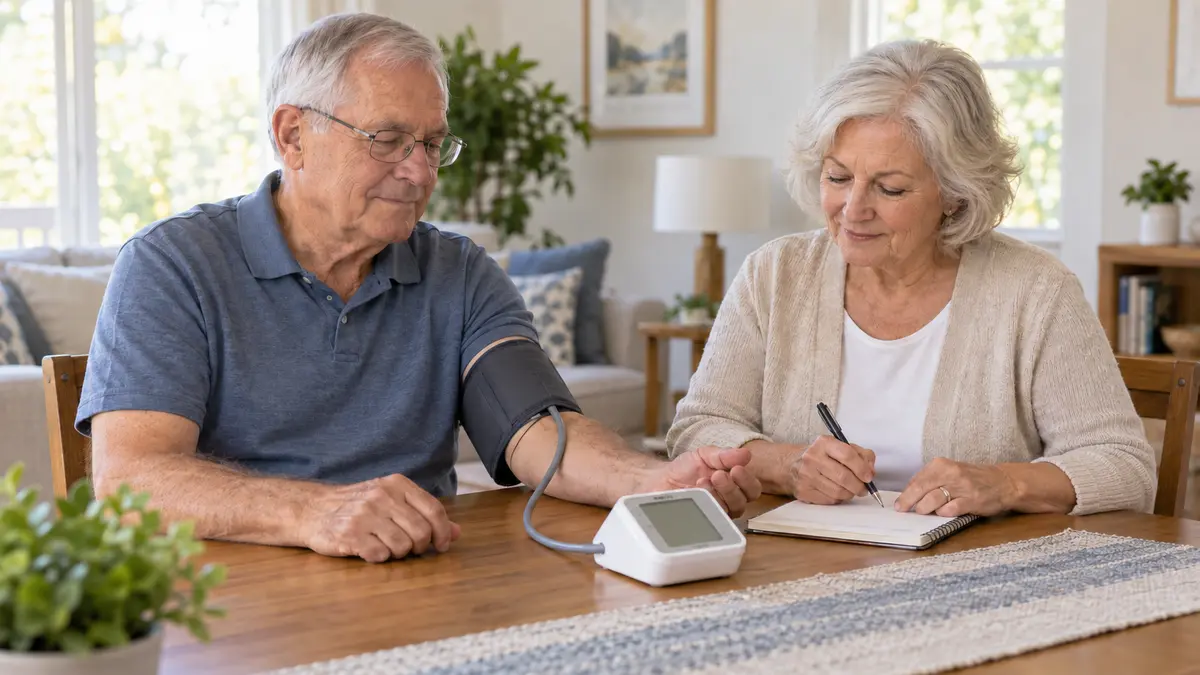
Good technique matters as much as the monitor.
Unless your clinician gives you different instructions:
- Avoid smoking, caffeinated drinks, alcohol, and exercise for at
least 30 minutes beforehand. - Empty your bladder and sit quietly for at least five minutes.
- Sit with your back supported, feet flat on the floor, and legs
uncrossed. - Place the cuff on bare skin rather than over clothing.
- Support your arm on a flat surface with the cuff at heart
level. - Stay still and do not talk while the monitor is running.
- Take two readings at least one minute apart and record both.
- Measure at approximately the same times each day if that matches
your clinician’s plan.
Bring the monitor to a medical appointment so a staff member can
check the cuff fit, your technique, and how its readings compare with
the office equipment.
When a Reading
May Require Immediate Attention
One high reading does not automatically mean there is an emergency.
Sit quietly and repeat the measurement using correct technique.
According to the American Heart Association, if a reading is higher
than 180/120 mm Hg, wait at least one minute and check
it again. If it remains that high, contact a healthcare professional
immediately. If it remains above 180/120 and you also have symptoms such
as chest pain, shortness of breath, back pain, numbness, weakness,
vision changes, or difficulty speaking, call 911.
Seek emergency help for serious symptoms even if you are uncertain
about the monitor. A home device should never delay urgent care.
1. Best Overall: OMRON
Platinum BP5465
The current OMRON Platinum BP5465 is a strong choice for older adults
who want a large display, generous memory, two-user support, and
optional app tracking.
Why It May Be a Good Choice
- High-contrast, backlit dual display with large numbers
- Separate storage for two users, with 100 readings per person
- TruRead mode that can take three consecutive readings and display an
average - Advanced averaging of recent readings
- Wide-range upper-arm cuff fitting arms from 9 to 17 inches
- Bluetooth connection to the OMRON Connect app
- Batteries and AC adapter included
- Storage case included
The monitor can screen for possible atrial fibrillation during a
blood pressure measurement. That screening is an alert to discuss with a
clinician, not confirmation that AFib is present.
Things to Consider
- It offers more features than someone wanting only basic readings may
need. - Bluetooth setup requires a compatible phone and app.
- The 9-to-17-inch cuff will not fit every arm.
- Correct positioning and technique are still essential.
Check the current OMRON Platinum BP5465 price on Amazon
2. Best Simple
Choice: OMRON 3 Series BP7150
The OMRON 3 Series BP7150 is easier to operate than the Platinum and
can be a better fit for one person who wants straightforward daily
measurements.
Why It May Be a Good Choice
- One-button operation
- Wide-range upper-arm cuff fitting arms from 9 to 17 inches
- Stores 14 readings for one user on the device
- Irregular-heartbeat and body-movement indicators
- Bluetooth support for the OMRON Connect app
- Clinically validated model listed by OMRON
The monitor works without using the app. Bluetooth is available for
someone who later decides to keep a longer digital history.
Things to Consider
- On-device memory is limited to 14 readings for one person.
- It does not have the Platinum model’s backlit dual display, two-user
memory, or automatic three-reading TruRead mode. - Check the live listing to confirm exactly what accessories are
included.
Check
current OMRON 3 Series BP7150 options on Amazon
3. Best
for Several Household Members: A&D Medical UA-767F
The A&D Medical UA-767F is worth comparing when several adults
want to use the same monitor. It provides four separate user profiles
rather than the two profiles commonly found on premium home
monitors.
Why It May Be a Good Choice
- Four user profiles
- Stores up to 60 readings per user
- One-button measurement
- Snapshot averaging
- Body-movement and irregular-heartbeat indicators
- Wide-range cuff fitting arms from approximately 8.6 to 16.5
inches
Things to Consider
- Four-user controls add a step before taking a reading.
- The display is functional but less modern than some premium
monitors. - Confirm whether the particular listing includes an AC adapter;
UA-767F bundles vary. - Measure every user’s arm because one included cuff may not fit
everyone.
Check the current A&D Medical UA-767F price on Amazon
4. Best Connected
Design: Withings BPM Connect
The Withings BPM Connect suits someone who prefers app-based records
and wants readings to synchronize through Wi-Fi or Bluetooth.
Why It May Be a Good Choice
- Compact, all-in-one upper-arm design
- Wi-Fi and Bluetooth synchronization
- Readings and trends stored in the Withings app
- Immediate color-coded feedback on the device
- Rechargeable battery
- Validated upper-arm cuff range of approximately 22 to 42
centimeters
The monitor can be convenient for sharing an organized history with a
caregiver or healthcare professional who accepts electronic reports.
Things to Consider
- Initial setup requires a compatible smartphone.
- Most of its value comes from using the app.
- Basic measurements and trends do not require a paid subscription,
but Withings offers an optional Withings+ membership. - A traditional monitor with a large screen may be easier for someone
who dislikes phone setup. - Confirm phone compatibility and privacy preferences before
buying.
Check the current Withings BPM Connect price on Amazon
Buying Checklist
Before ordering:
- Measure the user’s mid-upper-arm circumference.
- Check that the exact model—not merely the brand—appears on a
recognized validated-device list. - Decide whether the monitor will be used by one person, a couple, or
several household members. - Choose a display the user can read comfortably.
- Decide whether app tracking will genuinely be used.
- Check whether batteries, an AC adapter, and a storage case are
included. - Confirm the seller, warranty eligibility, and return policy.
- Ask a clinician whether a particular device or measurement schedule
is preferred for your situation.
Common Mistakes
- Choosing a wrist monitor only because it is smaller
- Ordering without measuring the arm
- Placing the cuff over clothing
- Taking a reading immediately after coffee, smoking, alcohol, or
exercise - Talking, crossing the legs, or leaving the arm unsupported
- Treating one reading as a diagnosis
- Assuming an irregular-rhythm alert confirms a medical condition
- Paying for connected features that will never be used
- Changing medication based only on home readings
Who Should Get Individual
Guidance?
Talk with a healthcare professional about home monitoring if:
- You are starting or changing blood pressure medication.
- You have an irregular heart rhythm, kidney disease, or another
complex condition. - Your readings vary widely or do not match measurements taken in a
medical office. - A standard upper-arm cuff does not fit properly.
- You have had surgery, swelling, dialysis access, or another reason
that may affect which arm or cuff should be used. - You develop new or concerning symptoms.
Home monitoring can support medical care, but it cannot replace
it.
Bottom Line
For most older adults, the best place to start is a validated
automatic upper-arm monitor with the correct cuff size and controls that
feel manageable.
The OMRON Platinum BP5465 is the strongest
all-around option here for its readable backlit display, two-user
memory, averaging features, and optional app connection. The
OMRON 3 Series BP7150 is a simpler choice for one user.
The A&D Medical UA-767F provides separate histories
for as many as four people, while the Withings BPM Connect is best suited to someone who genuinely wants app-based
tracking.
Whichever monitor you choose, careful technique and a consistent
routine matter more than buying the model with the longest feature list.
Record your readings and review the pattern with your healthcare
professional.
Product features, cuff sizes, compatibility requirements,
retailer listings, and prices can change. Verify important details with
the manufacturer and retailer before ordering. This article provides
general information and is not medical advice.
Related Reading
- Best
Fitness Trackers for Active Adults Over 50 - Heart
Rate Monitors for Walking and Cardiac Fitness - Best
Smartwatches for Older Adults - How to
Maintain Muscle After 60 - Browse Active
Aging Wearables Products